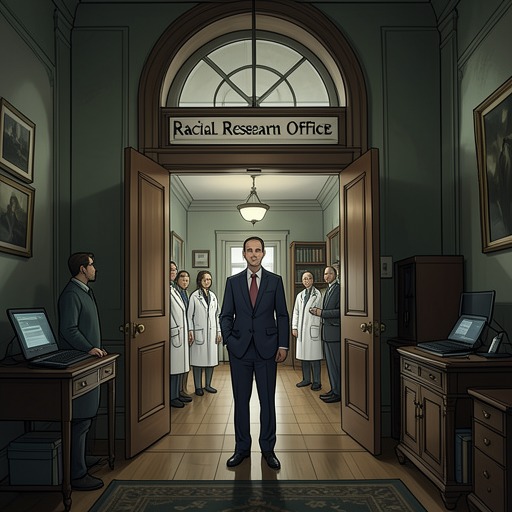
Nazi racial purity and classification policy
The Glass RoomNazi racial purity and classification policy operates in the novel through a biometric centre where the language of scientific neutrality masks a project of racial governance. Its staff collect personal and bodily data, assign people to racial categories, and send records into a system designed to find patterns that officials can use to define racial belonging. The contradiction at its heart is explicit: researchers admit that there is no single reliable marker of Jewish identity, yet the regime treats classification as a priority and pursues it as a basis for exclusion and control.
From scientific inquiry to racial administration
The centre’s subjects arrive by bus in groups of roughly twelve, separated by sex and of approximately the same age. Soldiers watch at the gate, while staff direct visitors inside without overt shouting or force. The process is presented as orderly and professional: the director insists that anthropologists should treat human subjects with the respect zoologists give animals. That calm procedure, however, does not make participation voluntary or the purpose neutral. The individuals are placed within a state-directed research system whose categories reflect Nazi racial doctrine.
At registration, staff record each person’s date and place of birth, languages, religion, race, and nation. The form also asks about past illnesses and conditions in a person’s ancestry, including intellectual disability, alcoholism, and criminality. These details are declared confidential and collected in the name of pure science. The form therefore does more than describe its subjects: it turns intimate histories into administrative data, joining family inheritance and personal identity to the regime’s attempt to define racial types.
The body made measurable
After registration, subjects complete tests involving shapes, sequences, and patterns, change into medical gowns, and undergo blood-group testing and blood-pressure measurement. Staff then take standardized physical measurements in pairs: one examiner positions the subject while another records the results. Height, hip and chest diameters, and limb measurements are taken; callipers measure head dimensions. Skin and eye colour are compared against standardized charts and models. The repeated assurances that the examination is scientific, confidential, and painless sit alongside a process in which the subject’s body is positioned, assessed, and recorded by others.
The procedures acquire an especially pointed meaning because their precision echoes the architecture of the Glass Room itself. The narrative links the room’s exact proportions to the centre’s cool, standardized measurements: both appear to promise rational order. But the measurements do not establish the objective racial boundaries their administrators seek. The appearance of exactness instead lends institutional authority to categories that remain politically imposed and scientifically unstable.
Categories, family, and racial hierarchy
The policy’s consequences are made clear in a discussion of the children of Liesel Landauer, who is described as German, and her Jewish husband, Viktor Landauer. A Nazi official calls the children Mischlinge and describes racial mixing as a curse, insisting that hybrids are unfit. Liesel counters that Ottilie and Martin are healthy, normal children. The official dismisses her response and says the centre is gathering evidence to identify the traits of each race so that racial purity can be preserved. In this exchange, a family relationship becomes an object of state classification, and the language of biological destiny is set against the children’s actual condition.
The centre’s ambitions extend beyond Jewish classification. Its researchers are also tasked with determining whether Slavs can be assimilated into German stock. When asked whether any single feature distinguishes a Jew from someone of Nordic stock, the research director agrees that there is none; a combination of characteristics remains only a possibility under investigation. The regime nevertheless demands progress, treating the proposed racial diagnosis as urgent and politically useful. Its categories are not simply findings awaiting discovery: they are instruments meant to sort populations according to the regime’s hierarchy.
Data systems and the limits of objectivity
The records move beyond the examination rooms. Monthly returns count people assessed by categories, while punched cards are duplicated and sent from the centre to Prague and then Berlin. There, Hollerith machines sort and assemble the data at a rate of 150 cards per minute, in the hope that patterns and correlations will disclose the keys to race and identity. The machinery gives classification an impersonal scale: the individual examined in the Glass Room becomes one record among many, available for aggregation and analysis.
The narrative’s account of these operations exposes a gap between the system’s certainty and its acknowledged limits. The researchers concede that no single characteristic can identify a Jew and that even a combination has not yet been established. Officials still press for results, including an assessment of whether Slavs can be absorbed into German racial categories. The policy’s claim to scientific objectivity therefore coexists with an explicitly political demand: produce classifications that can support racial purity and hierarchy, even where the evidence cannot sustain firm boundaries.
Classification as persecution
The policy’s stakes emerge in the regime’s treatment of people as subjects of racial inquiry and as targets of discrimination. During an inspection, Reinhard Heydrich asks whether the centre’s work can identify Jews and raises the possibility of inherited diseases. The research director qualifies that claim: the conditions are not present in all Jews, and people with those conditions are not all Jewish. He explains that the centre instead measures minute variations in phenotype and uses machines to sort the collected data. The exchange shows both the regime’s appetite for biological evidence and the investigators’ inability to make disease a dependable racial test.
Heydrich nevertheless instructs the researchers to find a conclusive Jewish characteristic and to pursue the question of Slavic racial status as a matter of priority. The demand reveals the function of the research: uncertainty is not allowed to restrain the political project. Classification supplies the regime with a rationale for dividing people into ranked groups, while its scientific vocabulary makes that division appear measurable and objective. The centre’s forms, instruments, photographs, and punched cards thus connect an individual’s body and family history to a wider administrative machinery of racial rule.